






Construction estimating is the process of calculating the expected cost of a construction project before work begins. It helps contractors and project teams understand how much a project is likely to cost and whether it can be delivered within budget.
Estimating involves calculating costs for materials, labour, equipment, overheads, and other project expenses. These figures are then used to prepare budgets, pricing, and project plans.
Key Takeaways
Construction estimating calculates the expected cost of a project before work begins.
Different estimate types are used throughout the project lifecycle, from feasibility studies to final budgets.
Accurate estimates require site reviews, material takeoffs, supplier pricing, and cost analysis.
Estimating software supports budgeting, procurement, cost tracking, and project management.

What Is Construction Estimating?
Construction estimating is the process of forecasting the cost of completing a construction project. It combines project requirements, quantities, and pricing data to produce an estimated project cost before construction starts.
A construction estimate includes direct costs such as materials, labour, equipment, and subcontractor services, as well as indirect costs like permits, insurance, supervision, and administrative expenses.
Construction estimates are commonly used to prepare project budgets, evaluate feasibility, and support tender submissions. They help contractors understand expected costs before committing to a project.
Why Accurate Estimating Matters
Accurate estimates help construction businesses avoid unexpected costs and keep projects financially on track. When costs are estimated correctly from the start, there is less risk of budget overruns during delivery.
Estimating also plays an important role in tendering. Contractors need pricing that is competitive enough to win work while still covering project costs and maintaining healthy margins.
Throughout the project, estimates provide a benchmark for monitoring spending and identifying cost variances. This supports stronger financial control for building projects and helps teams make informed decisions as work progresses.
Types of Construction Estimates
Different types of estimates are used at different stages of a project, with accuracy improving as more information becomes available.
Construction estimate accuracy generally improves as project details become more defined. Early estimates provide budgeting guidance, while later estimates support tender pricing and project execution.

Construction Estimating Methods
Construction estimators use different methods depending on the amount of project information available, the required level of accuracy, and the stage of the project. Many also use digital tools for contractors to improve estimating accuracy.
1. Unit Cost Method
The unit cost method estimates project costs by applying a cost rate to a measurable unit, such as square metres, cubic metres, or linear metres. It is commonly used during early planning when detailed project information is not yet available.
2. Stick Estimating
Stick estimating involves calculating the cost of each individual material, labour item, and project activity. While more time-consuming, it generally provides greater accuracy and is often used for tender submissions and detailed budgeting.
3. Parametric Estimating
Parametric estimating uses historical project data and cost models to predict future project costs. It allows estimators to produce cost forecasts quickly by applying predefined cost relationships to project variables.
4. Analogous Estimating
Analogous estimating uses the cost of similar completed projects as a reference point. It is most useful during the early stages of planning when detailed project specifications are still being developed.
How to Estimate Construction Costs
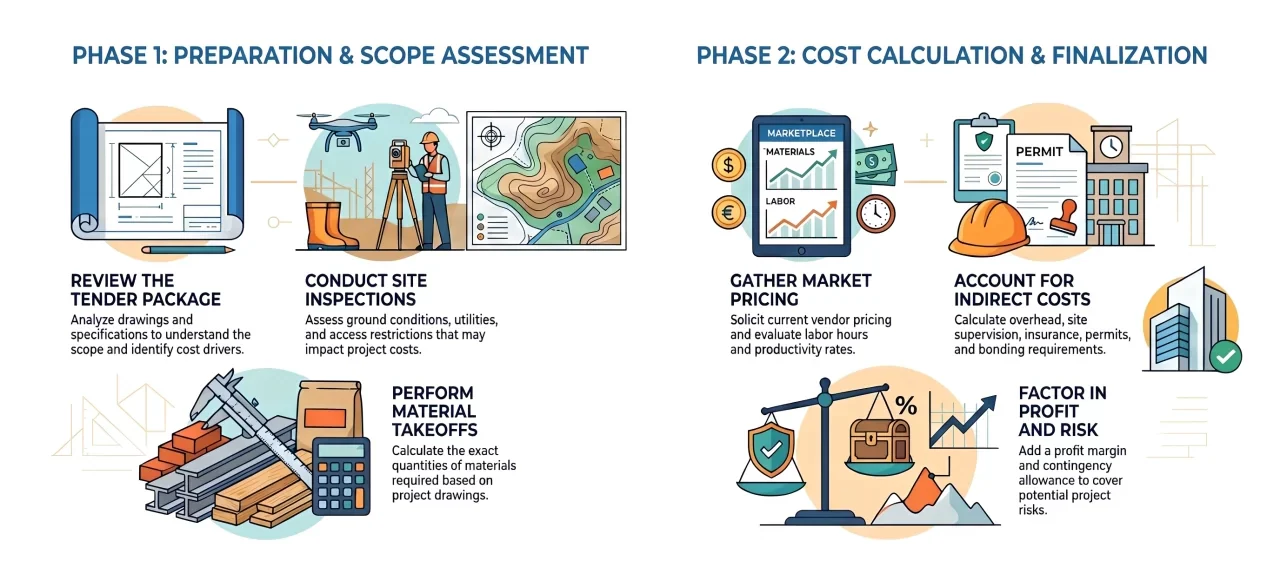
Accurate construction estimates require a structured process that considers project scope, site conditions, resource requirements, and potential risks before work begins.
1. Review the Tender Package
Review project drawings, specifications, schedules, and contract requirements to understand the scope of work and identify potential cost drivers.
2. Visit the Construction Site
Inspect site conditions to assess factors such as access restrictions, ground conditions, utilities, and environmental considerations that may affect project costs.
3. Perform a Material Takeoff
Calculate the quantities of materials required for the project based on drawings and specifications. This forms the foundation of the cost estimate.
4. Solicit Pricing from Suppliers and Vendors
Obtain current pricing for materials, equipment, and subcontracted services to ensure estimates reflect market conditions. This also supports improving material purchasing decisions before construction begins.
5. Evaluate Labour Requirements
Estimate labour hours, workforce requirements, and productivity rates needed to complete each stage of the project.
6. Determine Insurance and Bonding Costs
Include project-specific insurance, bonding, permits, and compliance costs that may be required before construction can commence.
7. Calculate Overhead and Indirect Field Costs
Account for expenses such as site supervision, temporary facilities, administration, utilities, and other indirect project costs.
8. Consider Profit and Contingency
Add a profit margin and contingency allowance to cover business objectives and potential project risks that may arise during construction.
Australian Construction Cost Benchmarks
Construction costs vary significantly depending on project type, location, design complexity, labour availability, and market conditions. The figures below provide a general indication of typical construction costs in Australia.
Construction costs can vary between metropolitan and regional areas due to differences in labour availability, transportation costs, and local market conditions.
These benchmarks should be used as a general reference only. Actual project costs may differ depending on project scope, specifications, site conditions, and procurement requirements.
Common Construction Estimating Mistakes
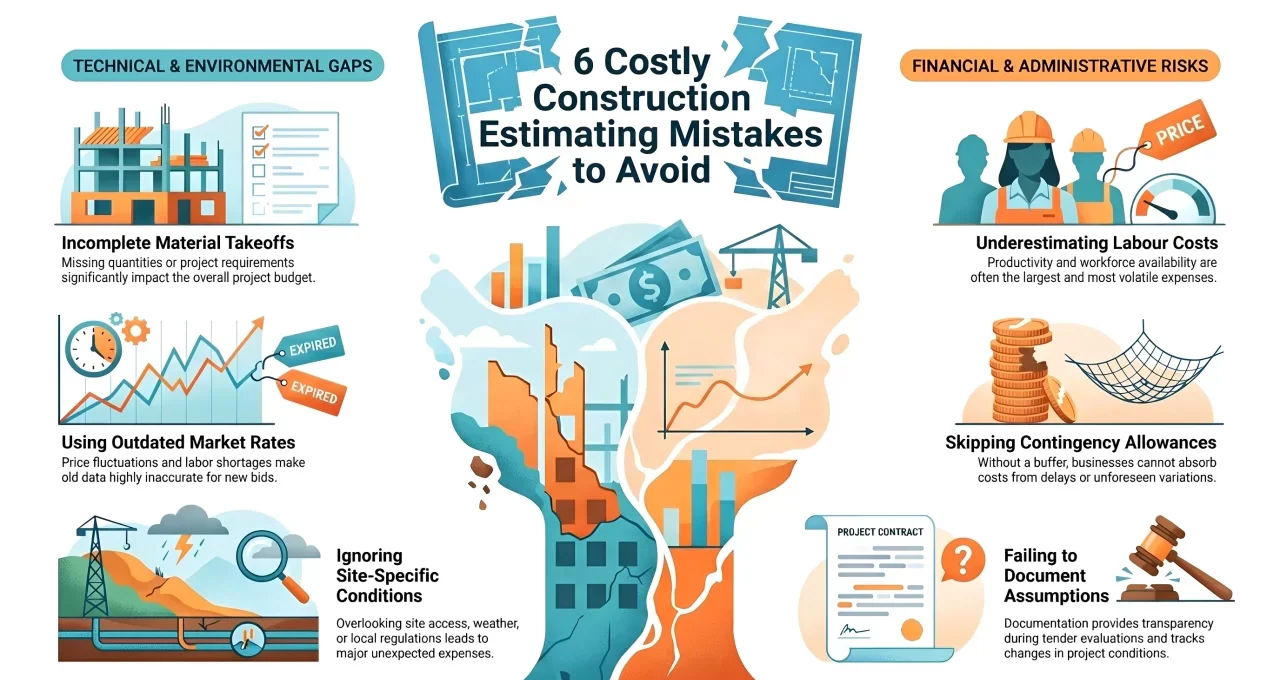
Even experienced estimators can make errors that affect project budgets and profitability. Understanding these common mistakes can help construction businesses improve estimate accuracy and reduce financial risk.
1. Incomplete Takeoff
Missing quantities or overlooking project requirements can result in underestimated material and labour costs. Even small omissions may have a significant impact on the overall project budget.
2. Using Outdated Rates
Construction costs can change quickly due to market conditions, labour shortages, and material price fluctuations. Using outdated pricing data may lead to inaccurate estimates.
3. Ignoring Site-Specific Conditions
Factors such as site access, ground conditions, weather, and local regulations can influence project costs. Failing to account for these conditions may result in unexpected expenses during construction.
4. Underestimating Labour Costs
Labour is often one of the largest project expenses. Inaccurate assumptions about productivity, workforce availability, or labour rates can affect overall project profitability.
5. Skipping Contingency Allowances
Unexpected issues can arise during any construction project. Without a contingency allowance, businesses may struggle to absorb additional costs caused by delays, variations, or unforeseen conditions.
6. Failing to Document Assumptions
Recording assumptions helps teams understand how estimates were developed and provides a reference when project conditions change. This also improves transparency during project reviews and tender evaluations when supported by project cost control tools.
How Estimating Software Fits Into Project Management
Estimating software helps construction businesses prepare more accurate estimates, reduce manual calculations, and centralise project data.
When integrated with budgeting, procurement, and job costing, it provides better visibility into project costs and helps teams monitor budgets more effectively.
Benefits of Construction Estimating Software
- Faster quantity takeoffs: Reduce the time required to measure and calculate project quantities.
- Consistent pricing data: Apply standardised pricing across estimates and projects.
- Improved budget control: Compare estimated and actual costs more effectively.
- Better project visibility: Access cost information and project data from a central location, supporting centralised construction project oversight.
- Reduced manual errors: Minimise calculation mistakes and duplicate data entry.
Many businesses use estimating tools alongside a construction management system to connect estimating, procurement, budgeting, and project delivery within a single platform.
Conclusion
Construction estimating helps businesses understand project costs before work begins and provides the foundation for budgeting, tendering, and financial planning. Accurate estimates reduce uncertainty and support better project decision-making.
By combining reliable estimating methods with structured cost management processes, construction businesses can improve profitability, control project spending, and reduce the risk of cost overruns.
If you are looking to improve construction estimating and project cost control, you can book a free consultation to see how integrated construction software can support your operations.

Frequently Asked Question
Construction estimating is the process of calculating the expected cost of a construction project before work begins.
The main types of construction estimates are preliminary, conceptual, detailed, and definitive estimates.
Estimating construction costs typically involves reviewing project requirements, performing material takeoffs, obtaining supplier pricing, assessing labour costs, and calculating overheads, profit, and contingency allowances.
An estimate calculates the expected project cost, while a tender is a formal proposal submitted to win a project based on that estimate.
Yes. Construction estimating software helps improve accuracy by automating calculations, standardising pricing data, and providing better visibility into project costs.