






Safety stock is the additional inventory held to prevent disruptions when demand or supply does not go as expected. It helps businesses avoid stockouts without relying entirely on perfect forecasting.
In practice, safety stock works by absorbing variability in demand and lead time. By setting the right buffer level, businesses can maintain availability, control costs, and keep operations stable without overstocking.
Key Takeaways
Understand how safety stock works as a control layer in inventory planning and how it helps absorb demand and supply uncertainty to keep operations stable.
Learn how to calculate safety stock using practical formulas and key variables such as demand variability and lead time to avoid overstocking or stockouts.
Identify the risks of poor safety stock planning and how mismanagement can lead to higher holding costs, dead stock, or lost revenue from stockouts.
Follow structured steps to determine the right safety stock level and ensure your inventory remains balanced between service level targets and cost efficiency.

What Safety Stock Actually Does in Inventory Planning
Safety stock acts as a control layer within inventory planning, not just extra inventory sitting on a shelf. It absorbs uncertainty, ensuring that daily operations continue even when demand or supply conditions shift unexpectedly.
By bridging the gap between forecast and reality, safety stock helps businesses maintain stability. It allows teams to respond calmly to disruptions rather than rushing into costly last-minute decisions.
Why Safety Stock Matters for Business Stability
Safety stock is not just a backup quantity; it functions as a strategic control that protects operations from volatility. It ensures that businesses can maintain performance, even when demand patterns or supply chains become unpredictable.
Prevent stockouts and lost revenue
Maintaining safety stock ensures products remain available even when demand exceeds expectations. This prevents missed sales opportunities and reduces the risk of customers switching to competitors.
Handle demand spikes
Sudden increases in demand can quickly deplete regular inventory levels. Safety stock provides the extra capacity needed to fulfil orders without delays or emergency replenishment.
Reduce supply chain disruptions
Delays in production, shipping, or supplier performance can interrupt inventory flow. Safety stock helps maintain continuity while the business waits for replenishment to arrive.
Improve forecasting accuracy
Consistent product availability ensures that sales data reflects actual demand rather than stock limitations. This leads to more reliable forecasting and better planning decisions over time.
Maintain customer satisfaction
Reliable stock availability builds trust and improves customer experience. When products are consistently available, businesses are more likely to retain customers and strengthen long-term relationships.
How to Calculate Safety Stock
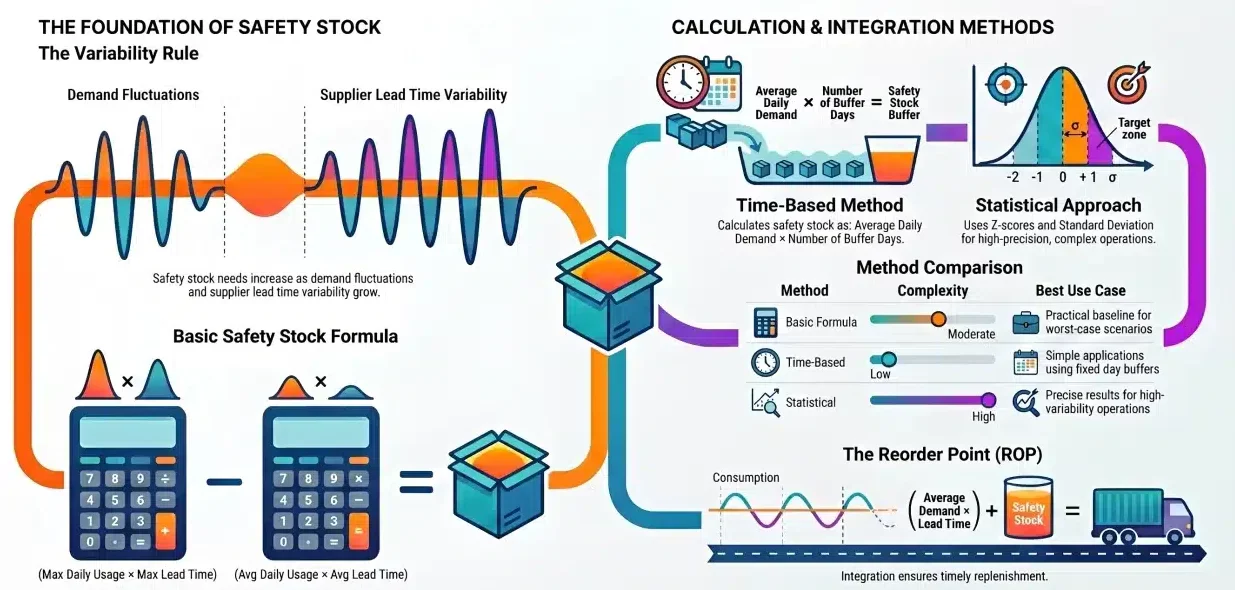
Accurately calculating safety stock is essential to avoid holding too much or too little inventory. A structured approach ensures the buffer is based on actual demand patterns and supplier performance, not guesswork.
Key variables (lead time and demand variability)
Safety stock calculations depend on how much demand fluctuates and how reliable supplier lead times are. The greater the variability in either factor, the larger the buffer required to maintain stability.
Basic safety stock formula
The most commonly used approach is:
Safety Stock = (Maximum Daily Usage × Maximum Lead Time)
− (Average Daily Usage × Average Lead Time)
This method provides a practical baseline by covering worst-case demand and delay scenarios.
Time-based calculation method
This method sets safety stock based on a fixed time buffer, such as holding a certain number of days’ worth of inventory:
Safety Stock = Average Daily Demand × Number of Buffer Days
While simple to apply, it may not fully capture real variability in demand or supply.
Advanced methods (statistical approach)
More advanced models use variability and service levels:
Safety Stock = Z-score × Standard Deviation of Demand × √Lead Time
These methods are more precise and better suited for complex or high-variability operations.
Reorder point connection
Safety stock works together with reorder planning:
Reorder Point = (Average Demand × Lead Time) + Safety Stock
This ensures replenishment happens before inventory reaches critical levels.

What Happens When Safety Stock Is Mismanaged
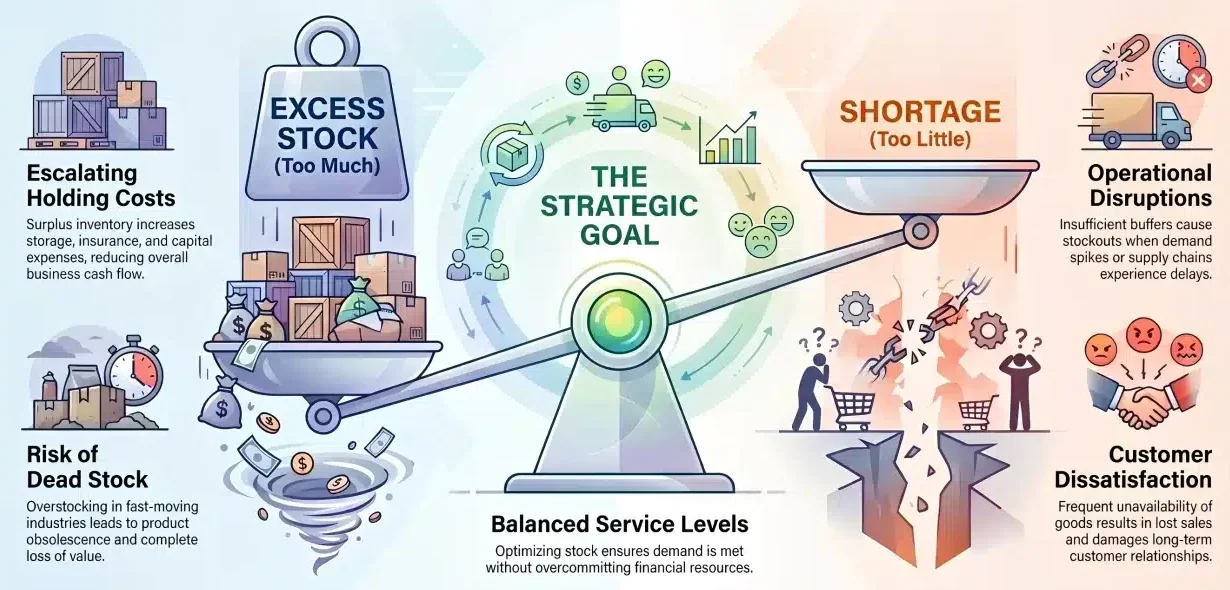
Managing safety stock requires balancing availability with cost. Too much buffer ties up capital, while too little increases the risk of disruptions, making accurate calculation critical.
Excess safety stock and holding costs
Holding more inventory than necessary increases storage, insurance, and capital costs. Over time, this reduces cash flow and limits the ability to invest in other areas of the business.
Risk of dead stock and obsolescence
Excess inventory can become outdated or unsellable, especially in industries with fast product cycles. This leads to markdowns, write-offs, or complete loss of value.
Insufficient safety stock and stockouts
Too little buffer increases the likelihood of stockouts when demand spikes or supply is delayed. This disrupts operations and can result in lost sales and customer dissatisfaction.
Balancing service level and inventory cost
The goal is to maintain enough stock to meet demand without overcommitting resources. Finding this balance helps businesses optimise service levels while keeping inventory costs under control.
Safety Stock in Real Business Scenarios
Safety stock becomes more meaningful when applied in real operations. Different industries use it in distinct ways depending on demand patterns, supply complexity, and risk tolerance.
Retail and e-commerce
Demand in retail can shift quickly due to promotions, trends, or seasonal changes. Safety stock helps ensure product availability during peak periods without relying on urgent restocking.
Manufacturing and production
Manufacturers depend on a steady flow of raw materials and components. Safety stock prevents production delays when suppliers face disruptions or lead times extend unexpectedly.
Healthcare and regulated industries
In sectors like healthcare, inventory availability is critical and often time-sensitive. Safety stock ensures essential supplies remain available while managing expiry risks and compliance requirements.
How to Set the Right Safety Stock Level
Setting the right safety stock level requires a balance between data, risk tolerance, and operational needs. A structured approach helps ensure decisions are consistent and aligned with business goals.
- Gather and clean historical data
Collect accurate data on demand patterns, sales volume, and supplier lead times. Clean data ensures calculations reflect real operational conditions. - Segment inventory (ABC analysis)
Categorise items based on value and importance. High-priority items typically require higher service levels and more precise safety stock planning. - Define service level targets
Determine acceptable stockout risk for each category. Higher service levels require larger buffers but improve availability. - Apply the right calculation method
Choose a formula that matches your level of demand and supply variability. Avoid using overly simple methods for complex scenarios. - Monitor and adjust regularly
Review safety stock levels periodically to reflect changes in demand, supplier performance, or market conditions.
The table below compares common safety stock calculation methods and when each approach is most appropriate.
| Method | Complexity | Best Use Case | Limitation |
| Basic formula | Low | Stable operations with moderate variability | Less precise for complex demand patterns |
| Time-based method | Low | Predictable demand environments | Ignores variability and risk factors |
| Statistical method | High | High variability demand or supply chains | Requires historical data and analysis |
| AI-based forecasting | Advanced | Large-scale or dynamic operations | Higher implementation complexity |
Common Mistakes in Safety Stock Planning
In most cases, issues with safety stock don’t come from the formula itself, but from how it’s applied in day-to-day operations. Without accurate data and regular review, even a correct calculation can lead to poor inventory decisions.
- Using outdated or inconsistent data
Many businesses rely on historical data that hasn’t been cleaned or updated to reflect current demand patterns. This often leads to buffer levels that no longer match actual operations. - Ignoring demand and lead time variability
For Australian businesses, lead times can vary significantly due to geographic distance and reliance on overseas suppliers. Overlooking this variability often results in underestimating the required buffer. - Applying one method across all products
Not all inventory behaves the same. Fast-moving items, seasonal products, and critical stock require different approaches, and using a single method reduces accuracy. - Not aligning with service level targets
Without clearly defined service levels, it becomes difficult to determine how much risk of stockouts is acceptable, especially in customer-facing industries. - Failing to review and adjust regularly
Market conditions, supplier performance, and demand patterns change over time. Safety stock that isn’t reviewed periodically can quickly become either excessive or insufficient.
Using Software to Optimize Safety Stock
Managing safety stock manually becomes increasingly difficult as operations grow more complex. With multiple variables and data points involved, systems help ensure calculations stay accurate and responsive to change.
ERP and automation
ERP systems automate safety stock calculations using integrated data from sales, purchasing, and inventory. This is particularly useful for Australian businesses managing stock across multiple locations or dealing with imported goods.
Predictive analytics
Data-driven forecasting tools analyse trends and demand patterns more accurately than manual methods. This allows businesses to adjust safety stock dynamically rather than relying purely on past averages.
Real-time tracking integration
Connecting safety stock planning with real-time inventory tracking improves visibility across warehouses and locations. It enables faster decision-making when demand shifts or supply delays occur.
Conclusion
Safety stock is not just a buffer, but a control mechanism that helps businesses stay stable when demand and supply don’t go as planned. When calculated and managed correctly, it improves availability while keeping inventory costs under control.
If your current process still relies on manual calculations or inconsistent data, it may be time to rethink your approach. Get a free consultation to explore how you can optimise safety stock planning with more accurate, system-driven insights.

Frequently Asked Questions About Safety Stock
How often should safety stock levels be reviewed?
Safety stock should be reviewed regularly, typically monthly or quarterly, depending on how frequently demand patterns and supplier performance change.
Does safety stock apply to all types of inventory?
Not always. Safety stock is most useful for items with variable demand or longer lead times, while stable, low-risk items may require minimal or no buffer.
What service level is typically used when calculating safety stock?
Most businesses use service levels between 90% and 99%, depending on how critical product availability is to operations and customer expectations.
Can safety stock be reduced without increasing stockout risk?
Yes, by improving demand forecasting accuracy, supplier reliability, and inventory visibility, businesses can often reduce safety stock while maintaining service levels.