




As supply chains become more complex, businesses are looking for ways to move products faster without increasing costs.
Cross-docking removes one of the biggest time and cost drains in logistics, storage and by moving goods straight from inbound trucks to outbound vehicles with almost no time spent in a warehouse.
For Australian businesses dealing with long freight routes, rising transport costs, and faster delivery expectations, this model delivers real, measurable advantages.
Key Takeaways
Understanding the five types of cross-docking helps businesses match the right approach to their supply chain from the start.
Businesses that shift high-velocity lines to a cross-dock model can achieve a 15 to 30% warehouse cost reduction while speeding up fulfilment at the same time.
Getting timing and synchronisation right from the start is what separates a smooth operation from a costly bottleneck.
A warehouse management system with ASN processing and real-time tracking keeps goods flowing accurately and outbound loads on schedule.

What Is Cross-Docking?
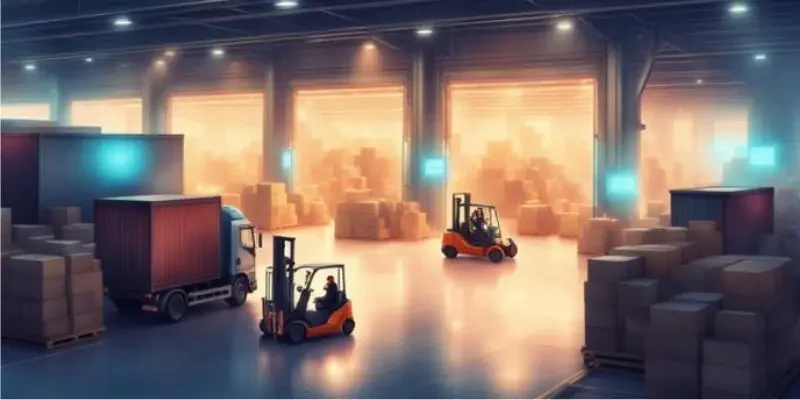
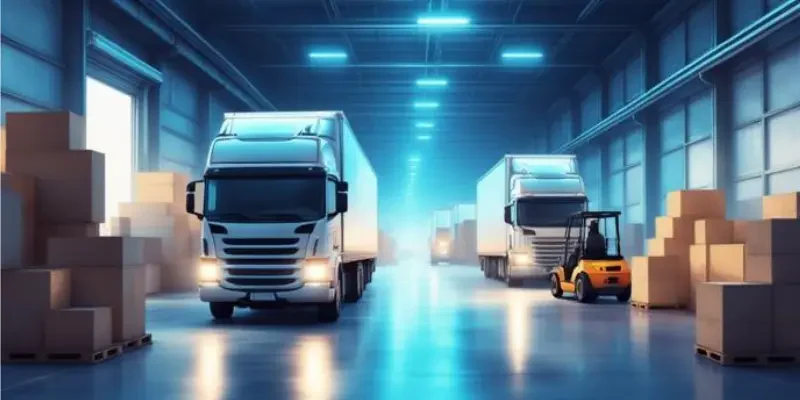
Cross-docking is a logistics method where goods arriving at a distribution centre are transferred directly to outbound transport with little or no storage time.
Unlike traditional warehousing, products are not stored on shelves before being dispatched. Instead, they are sorted and moved to outgoing vehicles shortly after arrival.
This approach is widely used by retailers, e-commerce businesses, food distributors, and manufacturers looking to speed up deliveries and reduce handling costs.
How Does a Cross-Docking Warehouse Work?
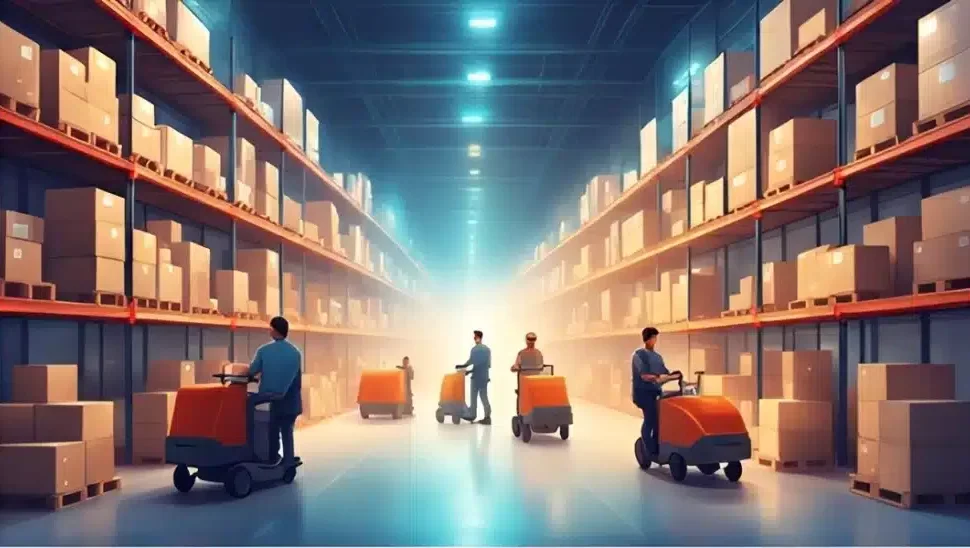
Cross-dock facilities are designed to move goods quickly through the supply chain rather than store inventory. Incoming shipments are unloaded, sorted, and prepared for outbound delivery within the same facility.
Products are checked, organised by destination, and briefly staged before being loaded onto outgoing vehicles. Depending on the shipment, goods may also be consolidated or repackaged.
Because the process relies on speed, efficient stock coordination and accurate scheduling between inbound and outbound deliveries are essential to avoid delays.

Types of Cross-Docking
Cross-docking can be implemented in several ways depending on how goods are sorted, transferred, and delivered. Each type is designed to meet different operational needs, from faster order fulfilment to lower freight costs.
1. Pre-Distribution Cross-Docking
In this model, products are sorted and labelled by destination before arriving at the facility. This allows goods to move directly from inbound to outbound transport with minimal handling, making it one of the fastest forms of cross-docking.
2. Post-Distribution Cross-Docking
Goods arrive without a fixed destination and are sorted at the facility based on current orders and demand. This approach offers greater flexibility but requires more coordination and real-time inventory visibility.
3. Opportunistic Cross-Docking
Products are transferred directly to outbound shipments when they match existing customer orders. This helps reduce storage time and is commonly used in fast-moving industries such as e-commerce and grocery distribution.
4. Consolidation Cross-Docking
Smaller shipments from multiple suppliers are combined into a single outbound load. This improves transport efficiency and can help reduce freight costs.
5. Deconsolidation Cross-Docking
A large inbound shipment is divided into smaller loads for delivery to multiple destinations. This method is often used by distributors and importers supplying products to different locations.
Benefits of Cross-Docking for Australian Businesses
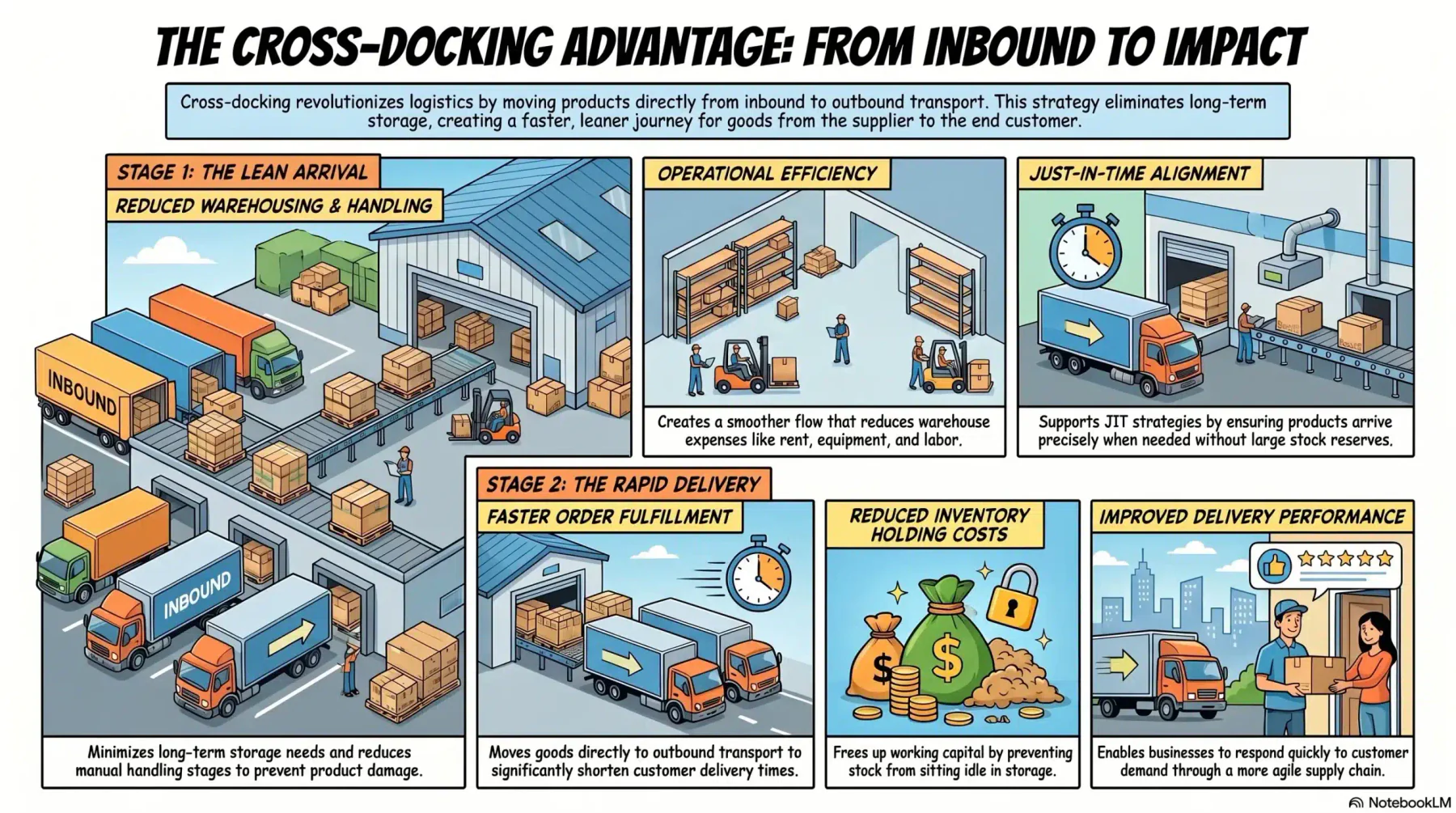
Cross-docking offers several advantages for Australian businesses, particularly those looking to reduce logistics costs and improve delivery performance. By keeping goods moving instead of storing them, businesses can create a faster supply chain with software for distribution efficiency.
1. Reduced Warehousing Costs
Cross-docking reduces the need for long-term storage, helping businesses lower warehouse expenses such as rent, equipment, utilities, and labour.
2. Faster Order Fulfilment
By moving products directly from inbound to outbound transport, businesses can shorten delivery times and respond more quickly to customer demand.
3. Lower Product Handling
Fewer handling stages mean there is less risk of products being damaged during storage, picking, packing, or transportation.
4. Improved Supply Chain Efficiency
Cross-docking helps goods move through the supply chain more smoothly, reducing delays and improving overall operational efficiency.
5. Reduced Inventory Holding Costs
With less inventory sitting in storage, businesses can free up working capital and reduce the costs associated with holding stock.
6. Better Support for Just-in-Time Delivery
Cross-docking aligns well with just-in-time inventory strategies by helping products arrive when needed without requiring large stock reserves.
Risks and Challenges of Cross-Docking
While cross-docking can improve speed and efficiency, it also comes with challenges. Businesses need strong coordination, reliable systems, and accurate planning to keep operations running smoothly.
1. Higher Risk of Product Damage
Products move through the facility quickly, which can increase the risk of damage if handling processes are not managed carefully, especially for fragile or high-value goods.
2. Dependence on Accurate Timing
Cross-docking relies on inbound and outbound shipments arriving on schedule. Delays from suppliers or transport providers can disrupt the entire process.
3. Complex Supplier and Carrier Coordination
Successful cross-docking requires close coordination between suppliers, carriers, and warehouse teams. Poor communication or inaccurate shipment information can create bottlenecks.
4. Technology and System Requirements
Businesses often need warehouse management systems, barcode scanning, and real-time inventory visibility to manage cross-docking efficiently and maintain accuracy.
5. Not Suitable for Every Product
Some products require additional storage, inspection, or special handling, making them less suitable for a cross-docking environment.
6. Upfront Setup Costs
Implementing cross-docking may require investment in facility upgrades, equipment, software, and process changes before businesses begin seeing long-term savings.
Cross-Docking vs Warehousing: Key Differences
Cross-docking and traditional warehousing serve different purposes. The main difference is that warehousing stores inventory for future use, while cross-docking focuses on moving goods through the supply chain as quickly as possible.
Warehousing is often better for slow-moving or seasonal products, while cross-docking works best for fast-moving goods that need rapid delivery.
Many businesses combine both approaches as part of broader warehouse operations strategies, using cross-docking for high-demand products and storage for the rest.
| Feature | Cross-Docking | Traditional Warehousing |
|---|---|---|
| Storage time |
Hours (under 24 hrs) | Days to months |
| Inventory holding |
Minimal to none | High |
| Best for |
Fast-moving, time-sensitive goods | Slow-moving, seasonal, or unpredictable demand |
| Handling touchpoints |
Low | High |
| Technology dependency |
High (WMS, ASN, real-time tracking) | Moderate |
| Upfront cost |
Higher infrastructure investment | Lower initial setup |
| Flexibility |
Lower, requires scheduling precision | Higher, accommodates demand variation |
| Damage risk |
Lower (fewer handlings) | Higher (more handlings) |
Real-World Cross-Docking Examples in Australia
Cross-docking is widely used across Australian industries to speed up deliveries and reduce storage costs. Retailers, logistics providers, and distributors use it to keep goods moving efficiently through the supply chain.
Major supermarket chains use cross-docking for preserving product freshness while replenishing stores with fresh produce and fast-moving products.
It is also common in food distribution, where importers quickly move products to multiple customers without long storage periods.
How Warehouse Management Software Enables Cross-Docking
A warehouse management system (WMS) helps make cross-docking more efficient by improving coordination, visibility, and accuracy as shipment volumes increase.
Features such as advance shipping notices (ASNs), dock scheduling, and real-time inventory tracking help teams plan shipments and reduce delays throughout the facility.
A WMS can also automate cross-docking workflows based on order priority and delivery requirements, helping businesses manage operations more effectively at scale.
Conclusion
Cross-docking can help businesses reduce warehousing costs, speed up deliveries, and minimise product handling throughout the supply chain.
For Australian businesses facing rising freight and distribution costs, it can be an effective way to improve logistics efficiency. However, cross-docking is not suitable for every operation.
Success depends on factors such as product type, supplier reliability, and the ability to coordinate shipments accurately. A warehouse management system can help support cross-docking by providing real-time visibility, shipment tracking, and dock scheduling.
Consult our experts to find out whether cross-docking is the right fit for your business.
Frequently Asked Question
Cross-docking is a process where incoming goods move directly from inbound docks to outbound vehicles without being stored. Staff sort shipments on the dock and load them onto delivery trucks, often within hours of arrival.
Cross-docking is a logistics strategy that moves goods through a facility quickly without storage. It is risky because the whole process depends on precise timing, and a single late shipment or missed pickup can disrupt the entire outbound schedule.
A common example is how Australian supermarkets handle fresh produce. Goods arrive overnight, get sorted by store destination, and load onto delivery trucks before dawn without ever going into storage.
The five types are pre-distribution, post-distribution, opportunistic, consolidation, and deconsolidation or breakbulk. Each type differs in where and when sorting decisions are made across the supply chain.
Cross-docked means a package passed through a distribution facility without going into storage. It was sorted and transferred directly to an outbound vehicle, which is why it typically moves faster through the delivery network.