





The traditional five-day schedule is no longer the only work model businesses are considering. In the Philippines, the conversation around a 4-day work week has gained fresh attention as employers look for ways to manage productivity, employee fatigue, and operational costs more strategically.
However, For many businesses, the real question is whether a shorter week can improve efficiency without disrupting payroll, customer coverage, and day-to-day coordination. That is why it is important to understand how a 4-day work week works, how it differs from a compressed workweek, and what companies need to prepare before adopting either setup.
Key Takeaways
Why 4-Day Work Week Is in Focus in the PhilippinesThis topic feels more relevant in the Philippines today because the conversation is no longer theoretical. In March 2026, the government announced a temporary four-day workweek in some executive offices as part of energy conservation measures and efforts to reduce the operational footprint of government agencies. That move pushed the concept back into public discussion and made many employers reconsider whether a shorter or compressed schedule could also help them manage costs, commuting pressure, and workforce fatigue. For Philippine businesses, the appeal goes beyond trend-following. Companies are operating in an environment shaped by traffic congestion, long commutes, rising utility pressure, and increasing employee expectations around flexibility. That is why the stronger angle for this article is not whether the 4-day work week sounds modern, but whether it can work in the Philippine setting without hurting service continuity, team coordination, or payroll accuracy. CSC advisory on flexible work arrangements also makes it clear that even flexible work arrangements must still preserve continuous service delivery, which is exactly where many businesses begin to hesitate. 4-Day Work Week vs Compressed Work WeekDOLE compressed workweek guidelines linking to the Department Advisory No. 02-04 page.
Pros and Trade-Offs of a 4-Day Week
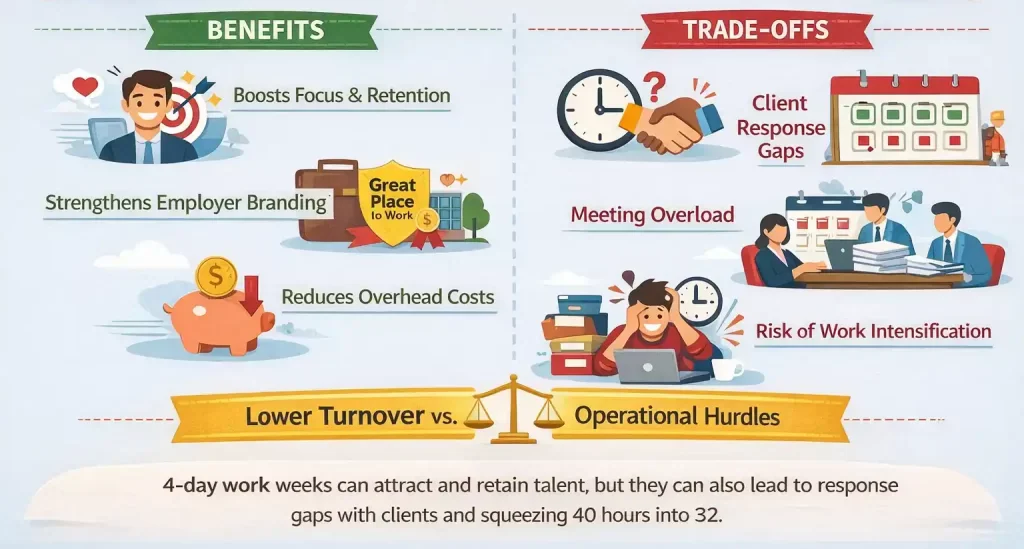
BenefitsWhen done properly, a 4-day work week can improve focus, reduce burnout, and strengthen retention. Many employees value time more than performative presence, so a shorter week can make an employer more attractive without immediately increasing salary costs. For businesses, that can translate into lower turnover, stronger morale, and better output from teams that are less exhausted and more intentional about how they use their time. The original draft also leans heavily on these retention, employer branding, and overhead-saving arguments, so that core direction should stay. Trade-OffsThe trade-offs are real, especially when clients, suppliers, and partners still operate on a five-day schedule. Response gaps can appear quickly, while compressed schedules may create work intensification if managers simply force the same workload into fewer days. Client coverage issues, meeting overload, and the risk of squeezing 40 hours of work into 32 productive hours can weaken the benefits if the setup is poorly planned. What Employers Must Check Before Adopting a Compressed Work Week
How HRIS and Payroll Software Support a 4-Day Work Setup
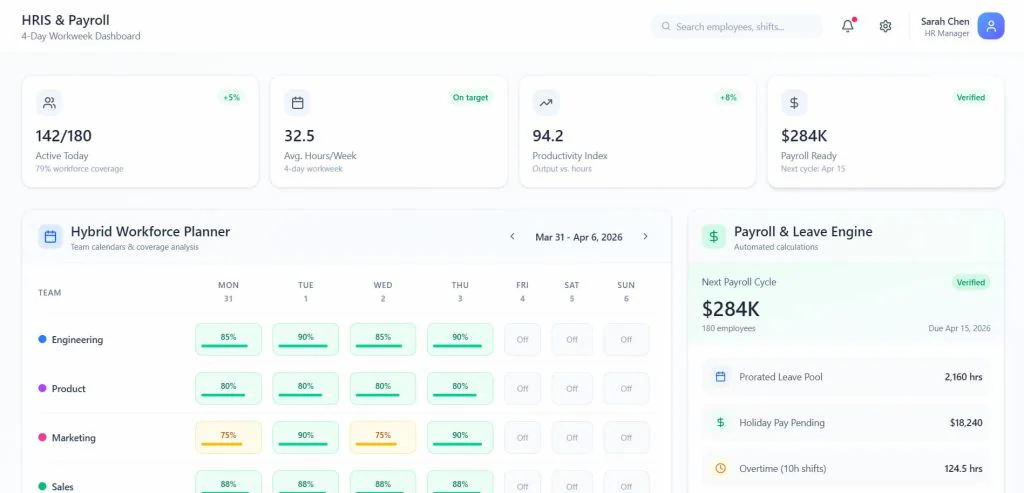
A four-day arrangement becomes harder to manage when HR still relies on spreadsheets, manual attendance checking, and fragmented approval flows. Different schedules across departments or employees reduce visibility quickly. Managers need to see who is working, who is off, and where coverage gaps exist without micromanaging the team.
Payroll and leave administration become more sensitive under a shorter or compressed workweek. A compressed schedule changes how companies treat working days, rest days, absences, and possible overtime exposure. Leave accrual becomes harder to manage when employees no longer follow a standard five-day pattern. Statutory holiday handling may require closer review depending on the setup. Payroll calculations become more complex when HR teams still depend on manual adjustments. Therefore, an integrated HRIS and payroll system makes the arrangement easier to sustain by centralizing attendance, leave rules, approvals, and payroll calculations. ConclusionA 4-day work week can offer real advantages, but it is not automatically the right fit for every business. The success of this setup depends less on trend appeal and more on whether your company can protect service continuity, manage schedules clearly, and keep payroll and attendance processes accurate as work arrangements change. For businesses exploring this shift, the next step is not just choosing a policy but making sure the system behind it can support daily execution. Reviewing HR and payroll software options for Philippine businesses can help you compare tools that make scheduling, attendance tracking, leave management, and payroll administration easier to handle under more flexible work arrangements. Frequently Asked Questions Around 4-day Work WeekIs the 4-day work week mandatory for the private sector in the Philippines in 2026?As of 2026, the 4-day work week remains voluntary for the private sector. While there have been several Executive Orders and legislative proposals to encourage its adoption, private companies have the flexibility to implement it as a “compressed workweek.” This means employees work 40 hours over four days (10 hours per day) instead of the traditional five, provided there is an agreement between the employer and the workforce. What is the latest DepEd update regarding the 4-day work week?The Department of Education (DepEd) has implemented pilot programs for administrative staff and certain non-teaching personnel to adopt a 4-day schedule to reduce operational costs and improve work-life balance. However, for schools and teachers, the standard 5-day instructional calendar remains the priority to ensure student learning hours are met, with flexible shifts being utilized only in specific high-density regions. Are employees entitled to overtime pay under a compressed 4-day work week?Under the guidelines for a compressed workweek in the Philippines, if an employee agrees to work 10 hours a day for 4 days to complete the 40-hour requirement, the extra 2 hours per day are not considered overtime. Overtime pay only applies if the employee exceeds the agreed-upon 10 hours in a day or works beyond the 40-hour weekly limit. It is crucial for businesses to use an automated HRIS in Philippines to track these specific shift configurations accurately. How does the 4-day work week work at the University of the Philippines (UP)?The University of the Philippines has been a leader in testing flexible work arrangements. Under current guidelines, specific units within the UP system may adopt a 4-day workweek for administrative employees to mitigate commuting stress and lower carbon footprints. These arrangements are usually managed at the departmental level to ensure that essential campus services remain accessible to students throughout the standard week. HashMicro follows strict editorial standards and uses primary sources such as regulations, industry guidance, and trusted publications to keep content accurate and relevant.       Chat Now : |

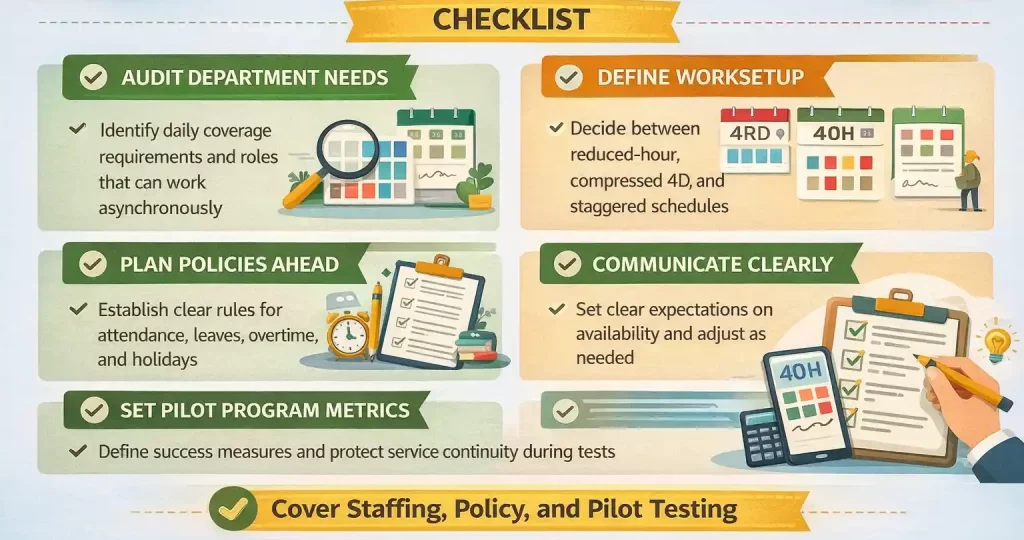 Step 1: Decide whether the company will use a reduced-hour schedule, a compressed 40-hour workweek, or a staggered team arrangement. Each model affects staffing, payroll, and customer coverage differently.