






Every purchase a business makes follows a chain of steps, from the initial request through to the final payment. When that chain is fragmented, costs show up as late payments, duplicate invoices, and supplier disputes.
The procure to pay process gives Australian businesses an integrated procurement management to work with. It connects procurement and accounts payable into one continuous workflow rather than two disconnected functions.
This article covers how procure to pay works, the key components involved, and the practices that help businesses run the process more efficiently and compliantly.
What Is Procure to Pay?
Procure to pay (P2P) is the end-to-end cycle that covers every activity from raising a purchase request through to paying the supplier. It connects procurement, receiving, invoice processing, and accounts payable in one continuous workflow.
The P2P process gives finance and procurement teams a shared framework for controlling spend. When it works well, every purchase is authorised, every invoice is verified, and every supplier is paid on time.
For Australian businesses, a well-run P2P process also supports GST compliance, accurate BAS reporting, and audit readiness. Without it, purchasing becomes reactive and payment errors accumulate over time.
Key Components of the Procure to Pay Process

The procure to pay process breaks down into five core components. Each one feeds into the next, and a gap in any area affects the accuracy and efficiency of the entire cycle.
The five components are as follows.
1. Purchase requisition and approval
A purchase requisition is the formal internal request that starts the P2P cycle. The requesting team submits what is needed, the estimated cost, and the business justification, which then routes through the relevant approval chain.
Approval controls at this stage stop unauthorised spending before it reaches the supplier and create the first entry in the audit trail.
2. Purchase order creation and management
Once the requisition is approved, procurement raises a purchase order and sends it to the supplier. The PO documents the agreed items, quantities, prices, delivery dates, and payment terms.
The purchase order is the anchor document for the rest of the P2P process. Every subsequent activity, including goods receipt and invoice matching, refers back to it.
3. Goods and services receipt
When the supplier delivers, the receiving team checks the goods or services against the purchase order. Any discrepancies in quantity, quality, or specification are recorded immediately and communicated back to the supplier.
Accurate goods receipt records are essential because they form one of the three documents used in three-way matching.
4. Invoice processing and three-way matching
The supplier submits an invoice, and the accounts payable team compares it against the purchase order and goods receipt note. If all three documents correspond, the invoice moves forward for payment approval.
Three-way matching reduces the risk of paying for goods not received, approving duplicate invoices, or processing incorrect pricing.
5. Supplier payment and reconciliation
Once the invoice clears matching, payment is processed according to the agreed terms. The transaction is then reconciled in the system for purchasing automation and the supplier record is updated.
Paying suppliers accurately and on time protects those relationships and strengthens the business’s reputation as a reliable commercial partner.
Procure to Pay Process: Step by Step
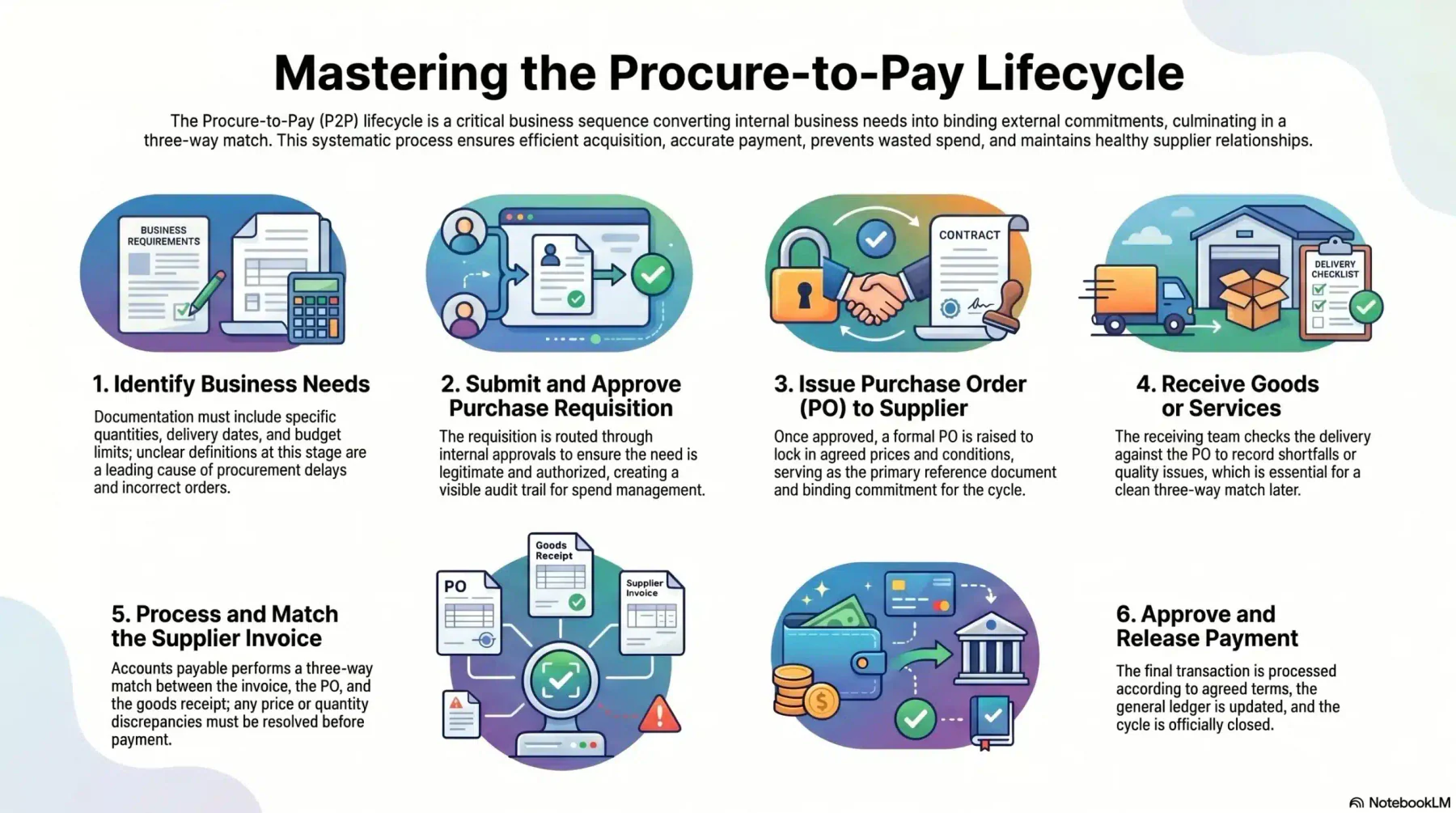
Understanding each activity in sequence makes it easier to identify where the P2P process slows down or breaks down. The six activities below cover the full flow from need identification through to payment release.
1. Identify business needs
The cycle begins when a team identifies a requirement for goods or services. The need is documented with specifics, including quantities, delivery dates, and budget limits, so procurement can act on accurate information.
Unclear requirement definitions are one of the most common causes of procurement delays and incorrect orders. Getting this right at the start prevents scope changes and wasted spend further down the cycle.
2. Submit and approve a purchase requisition
The requesting team submits a purchase requisition, which routes through internal approval. This confirms the need is legitimate, budgeted, and authorised before any supplier engagement begins.
Requisitions create a visible audit trail from the earliest point in the cycle and help procurement teams manage spend across the business.
3. Issue a purchase order to the supplier
With the requisition approved, procurement raises a formal purchase order and sends it to the supplier. The PO locks in the agreed price, quantity, and delivery conditions.
This step converts an internal approval into a binding commitment with the supplier and creates the primary reference document for the rest of the P2P cycle.
4. Receive goods or services
When the supplier delivers, the receiving team checks the delivery against the purchase order. Any shortfalls, quality issues, or substitutions are recorded and escalated before the invoice arrives.
Accurate goods receipt records are essential for a clean three-way match and protect the business from paying for what it did not receive.
5. Process and match the supplier invoice
The supplier submits an invoice, and accounts payable matches it against the purchase order and goods receipt note. If all three documents align, the invoice moves to payment approval.
Any exceptions identified during matching, such as price differences or missing receipt records, are resolved before payment is released.
6. Approve and release payment
The approved invoice is processed for payment on the agreed terms. The transaction is reconciled against the relevant purchase order and recorded in the general ledger.
Completing this step closes the cycle and updates both the supplier record and the business’s financial reports.
Procure to Pay vs Source to Pay vs Purchase to Pay
The terms procure to pay, source to pay, and purchase to pay are often used interchangeably, but they describe different scopes of activity. Understanding the differences helps businesses choose the right tools and apply the right focus to each part of the purchasing process.
1. How the three processes differ
Procure to pay covers the transactional cycle from purchase requisition through to supplier payment. It focuses on execution accuracy, approval controls, and payment efficiency.
Source to pay (S2P) extends to the connected procurement lifecycle that includes supplier sourcing, evaluation, and contract negotiation before any purchase order is raised.
Purchase to pay is simply another name for P2P, more commonly used in finance and ERP contexts.
2. Where P2P fits within the broader procurement lifecycle
P2P sits in the middle of the procurement lifecycle. It starts after a supplier has been selected and a contract is in place, and ends when the supplier is paid and the transaction is reconciled.
Strategic activities such as spend analysis, supplier selection, and contract management fall within the source to pay scope and feed directly into the start of the procure to pay process.
3. When each approach suits your business
Businesses focused on transactional efficiency and payment accuracy benefit most from optimising their P2P process. Those aiming to improve supplier relationships, contract terms, or long-term sourcing strategies need the broader source to pay framework.
For most Australian businesses, improving P2P delivers the most immediate return, as it directly affects cash flow, supplier trust, and day-to-day compliance.
For a quick side-by-side comparison, the table below summarises where each process starts, what it covers, and when it suits your business.
Feature |
Procure to Pay (P2P) |
Source to Pay (S2P) |
Purchase to Pay |
Process start |
Purchase requisition | Supplier identification and sourcing | Purchase requisition |
Process end |
Supplier payment and reconciliation | Supplier payment and reconciliation | Supplier payment confirmation |
Includes sourcing and contracting |
No | Yes | No |
Primary focus |
Approval controls and payment efficiency | Supplier strategy, sourcing, and contracting | Order processing and payment workflows |
Best suited for |
Businesses optimising transaction accuracy and compliance | Businesses improving sourcing outcomes and supplier management | Finance teams focused on payment processing |
Typical tools |
ERP, AP automation, eInvoicing | Procurement suites, contract management systems | ERP, accounts payable software |
eInvoicing and the Procure to Pay Process in Australia
Australia’s national eInvoicing framework is changing how businesses exchange invoices with suppliers and government entities. For businesses running a P2P process, eInvoicing affects invoice receipt, processing speed, and compliance obligations directly.
1. What eInvoicing means for Australian businesses
eInvoicing in Australia uses the Peppol network to exchange structured invoice data directly between accounting systems. It replaces PDF invoices sent by email with machine-readable data that enters the accounts payable system automatically.
The ATO and the federal government encourage businesses to adopt eInvoicing, particularly those transacting with Commonwealth agencies. Suppliers to the Commonwealth government are expected to send invoices via Peppol-enabled channels.
2. How eInvoicing reduces invoice processing time
Because eInvoicing delivers structured data directly into the accounts payable system, it removes the manual data entry step entirely. The invoice arrives pre-populated and ready for three-way matching without any keying.
That change eliminates a major source of delay and error in the P2P process. Businesses that move from PDF to eInvoicing typically see processing times fall from days to hours.
3. Compliance requirements under the Australian framework
Australian businesses transacting with government agencies must support Peppol-format invoicing. For private sector businesses, eInvoicing is not yet mandatory, but the ATO strongly encourages adoption as part of its broader digital economy strategy.
Businesses using procurement software solution such as Xero, MYOB, or an ERP platform should confirm their system supports Peppol connectivity and update their invoice workflows accordingly.
How P2P Supports GST Compliance for Australian Businesses
GST compliance depends on the accuracy and completeness of invoice and purchase order data. A well-run procure to pay process builds that accuracy into every transaction rather than treating compliance as a separate exercise.
1. Linking invoice data to BAS reporting
Every tax invoice processed through the P2P cycle feeds into the input tax credit calculations on the Business Activity Statement. When invoice data is captured accurately and matched to a purchase order, BAS preparation becomes straightforward.
Errors in invoice coding, missing ABN details, or mismatched amounts create reconciliation problems at BAS time. Embedding GST checks into the P2P workflow prevents those errors from building up.
2. Managing input tax credits within the P2P cycle
Input tax credits can only be claimed on valid tax invoices. For invoices above $82.50 (including GST), the ATO requires the supplier’s ABN, the GST amount, and a description of the goods or services.
A P2P process that validates these fields at invoice receipt reduces the risk of claiming credits on non-compliant documents that may be disallowed in an ATO review.
3. Common GST errors in accounts payable
The most frequent errors include claiming credits on invoices without a valid ABN, double-coding invoices across reporting periods, and miscoding the GST treatment on mixed-supply invoices.
A structured P2P process with clear coding rules and approval checks at invoice entry significantly reduces these errors and supports cleaner BAS outcomes.
Procure to Pay KPIs and Metrics to Track
Measuring P2P performance gives procurement and finance teams the data they need to identify bottlenecks and justify improvements. The four metrics below are the most widely tracked in Australian businesses running a formal P2P process.
1. Purchase order cycle time
Purchase order cycle time measures the duration from requisition submission to PO issuance. A long cycle time typically points to approval delays, unclear requirement definitions, or a lack of automation in the requisition workflow.
Reducing PO cycle time shortens the lead time between need identification and supplier action, which directly improves delivery performance and stakeholder satisfaction.
2. Invoice processing cost per document
This metric captures the total cost of processing a single supplier invoice, including staff time, system costs, and error resolution. Manual invoice handling in Australian businesses can cost between $15 and $40 per document depending on complexity.
Automating invoice receipt, data capture, and matching typically reduces this cost significantly and frees accounts payable staff to focus on exception management rather than routine processing.
3. Supplier on-time payment rate
Supplier on-time payment rate tracks the percentage of invoices paid within the agreed payment terms. A low rate signals approval bottlenecks, invoice disputes, or cash flow constraints preventing timely payment.
For Australian businesses, late payment carries an additional layer of accountability. The Commonwealth Government’s Payment Times Reporting Scheme requires large businesses to report how quickly they pay small business suppliers.
4. Three-way match rate
Three-way match rate measures the percentage of invoices that pass automated matching on the first attempt, without manual intervention. A high match rate indicates clean data across purchase orders, receipts, and invoices.
A low match rate signals data quality issues, supplier invoice errors, or process gaps in goods receipt documentation that need to be addressed upstream in the P2P cycle.
Challenges in the Procure to Pay Process
Most P2P problems are predictable. The same issues appear across businesses of different sizes and industries, and they nearly always trace back to one of the following root causes.
1. Manual workflows and approval delays
Manual requisitions, paper-based approvals, and email-driven invoice handling slow the P2P cycle at every stage. Each handoff introduces delays, and each manual entry creates an opportunity for errors that take time to resolve.
Approval delays are particularly costly because they hold up purchase orders, extend lead times, and frustrate both internal stakeholders and suppliers waiting for confirmed orders.
2. Maverick spending and policy non-compliance
Maverick spending occurs when employees purchase goods or services outside the approved P2P process, bypassing preferred suppliers and contract terms. It inflates costs, creates compliance risks, and undermines supplier relationships built through formal procurement.
The most effective controls are clear procurement policies, easy-to-use requisition tools, and visibility into who is spending what and with which suppliers.
3. Lack of visibility across procurement and finance
When procurement data sits in one system and accounts payable data sits in another, neither team has a complete picture of the purchasing cycle. That fragmentation makes it difficult to track spending, identify duplicates, or forecast cash flow accurately.
Centralising spend data into a single platform is one of the most impactful changes a business can make, as even a basic shared system significantly improves decision-making across both functions.
4. Disparate systems and data silos
Many Australian businesses run procurement on spreadsheets, invoices through email, and payments through accounting software, with no direct connection between them. Each system creates a silo and requires manual reconciliation at every boundary.
Integrating these systems, or replacing them with a single platform, eliminates that overhead and gives both teams a shared, real-time view of the P2P cycle.
Procure to Pay Across Industries in Australia

The core P2P process applies across all industries, but the specific pressures and priorities differ by sector. The three contexts below illustrate how Australian businesses adapt the process to their operating environment.
1. Manufacturing and industrial supply chains
Manufacturing businesses typically manage high volumes of purchase orders across a large supplier base. Accurate goods receipt documentation is critical because it feeds directly into inventory records, production scheduling, and cost of goods calculations.
Three-way matching is especially valuable in this sector, where pricing errors or incorrect deliveries have a direct impact on production costs and margins. ERP integration between procurement, inventory, and finance is standard practice.
2. Healthcare and public sector procurement
Healthcare and public sector businesses operate under strict compliance requirements that govern how suppliers are engaged, how contracts are managed, and how payments are processed. The P2P process must support detailed audit trails and adhere to procurement policies set at the agency or health network level.
For public sector entities in Australia, P2P processes also intersect with eInvoicing compliance requirements and the Commonwealth Procurement Rules, which set standards for supplier payment terms and reporting transparency.
3. Retail and wholesale distribution
Retail and wholesale businesses deal with high invoice volumes, short payment cycles, and suppliers ranging from large distributors to small local producers. Speed and accuracy in invoice processing are essential for maintaining supplier relationships and controlling working capital.
Many retail businesses run vendor-managed inventory or consignment arrangements that require customised receipt and matching workflows to account for variable delivery quantities and pricing structures.
Common Mistakes in Procure to Pay
Even well-intentioned P2P processes break down when certain fundamentals are overlooked. The three mistakes below are among the most common and the most costly for Australian businesses.
1. Skipping the three-way matching process
Approving invoices without matching them to a purchase order and goods receipt note is one of the most significant financial control gaps a business can have. It exposes the business to overpayments, duplicate payments, and fraud.
Some businesses skip matching for low-value invoices or trusted suppliers, but this creates inconsistency in the process and makes it harder to maintain a clean audit trail.
2. Relying on manual invoice handling
Manual invoice handling through email inboxes, spreadsheets, or paper files slows processing times and introduces errors at every stage. As invoice volumes grow, manual systems become progressively harder to manage and more prone to mistakes.
Transitioning to automated invoice capture and matching is one of the most direct investments a business can make in P2P efficiency, with measurable reductions in cost per invoice and processing time.
3. Failing to track supplier performance data
The P2P process generates significant supplier performance data, including delivery accuracy, invoice error rates, and dispute resolution times. Many businesses collect this data but never analyse or act on it.
Regular supplier performance reviews based on P2P data help procurement teams make informed decisions about which supplier relationships to develop, renegotiate, or exit.
Best Practices for Procure to Pay Management
Businesses that run their P2P processes well share a consistent set of practices. These require deliberate effort to establish and maintain, but the returns show up across cost, accuracy, and supplier performance.
1. Standardise procurement policies across all departments
Consistent procurement policies reduce maverick spending, speed up approvals, and make it easier to train new team members. When every department follows the same process, procurement becomes more predictable and easier to audit.
Standardisation starts with documenting current processes and identifying where variation between teams is creating errors or delays. Removing that variation is usually more impactful than adding new tools.
2. Build a vetted and centralised supplier database
A centralised supplier database ensures procurement teams always work from an approved vendor list with current contact details, ABN records, bank account information, and contract terms on file.
It also reduces the risk of fraud from fictitious suppliers and makes it faster to raise purchase orders when a new requirement arises. Keeping the database current requires regular review and a clear process for onboarding new suppliers.
3. Monitor KPIs regularly to identify bottlenecks
Tracking P2P KPIs on a regular cadence, rather than only when problems arise, gives procurement and finance teams the data they need to act before a bottleneck becomes a crisis.
Monthly reporting on PO cycle time, invoice processing cost, match rate, and on-time payment rate provides a clear picture of where the process is performing well and where it needs attention.
4. Use an ERP system to automate the end-to-end P2P cycle
An ERP system connects purchase requisitions, purchase orders, goods receipt, invoice matching, and payment processing in a single platform. That integration eliminates the data silos that cause most P2P problems.
For Australian businesses managing growing transaction volumes, ERP-driven automation reduces processing times, cuts error rates, and gives finance leadership real-time visibility across the entire procure to pay cycle.
Conclusion
A well-managed procure to pay process does more than keep the bills paid. It gives businesses control over spend, reduces compliance risk, and creates the foundation for stronger supplier relationships.
The difference between a reactive P2P process and a well-run one usually comes down to structure: clear policies, integrated systems, and consistent measurement. Businesses that invest in those fundamentals see the results across cost, accuracy, and supplier performance.
Star growing and consult our experts to find out where automation can make the biggest difference in your procure to pay cycle.
Frequently Asked Questions
What is the difference between procure to pay and source to pay?
Procure to pay covers the transactional cycle from purchase requisition through to supplier payment. Source to pay is broader, extending upstream to include supplier sourcing, evaluation, and contract negotiation before any purchase order is raised. In practice, procure to pay starts once a supplier and contract are already in place, while source to pay starts at the point of identifying a supplier need.
How does eInvoicing affect the procure to pay process in Australia?
eInvoicing replaces manual PDF invoice handling with structured data exchanged directly between accounting systems via the Peppol network. For the P2P process, invoices arrive pre-populated and ready for three-way matching without manual keying. Processing times typically fall from days to hours, error rates drop, and the business is better positioned to meet the ATO’s eInvoicing requirements for government transactions.
What are the most important KPIs in a procure to pay process?
The four most widely tracked P2P metrics are purchase order cycle time, invoice processing cost per document, supplier on-time payment rate, and three-way match rate. Together, they cover the speed, cost, accuracy, and compliance dimensions of the procure to pay cycle. Monitoring all four regularly gives procurement and finance teams a complete picture of where the process is performing and where it needs attention.
Can small businesses in Australia benefit from a formal P2P process?
Yes. Even small businesses benefit from a structured P2P process, particularly around GST compliance and supplier payment accuracy. A basic framework with documented approval steps and consistent invoice coding reduces BAS errors, prevents duplicate payments, and makes supplier relationships easier to manage. Cloud accounting tools such as Xero and MYOB support many of the core P2P controls without requiring a full ERP system.
How does three-way matching work in procure to pay?
Three-way matching compares three documents: the purchase order, the goods receipt note, and the supplier invoice. If the quantities, prices, and items across all three correspond, the invoice is approved for payment. If any document shows a discrepancy, the invoice is held for manual review before payment is released. Three-way matching is the primary financial control in the procure to pay process and significantly reduces the risk of incorrect or fraudulent payments.